Tues - Friday 10 - 5:30, Thurs 10 - 4, Sat 11 - 4
Ruby, the July Birthstone: History, Symbolism, and Why Collectors Love It
Few gemstones command attention quite like the ruby. Its deep, glowing red has stood for love, courage, and vitality across nearly every culture that ever prized it, and as the birthstone for July, it carries that meaning straight into summer. Today, ruby is celebrated as one of the four precious stones, sitting alongside diamond, sapphire, and emerald, and it remains one of the most desirable colored gems in the estate market.
For collectors and July babies alike, antique and vintage ruby pieces offer something modern jewelry rarely can: a stone with genuine history, rich natural color, and a design pedigree that spans centuries. Lippa’s curated selection of gemstone rings shows just how striking these red stones can be when set by hand in gold or platinum.
Why Is Ruby the July Birthstone?
Ruby was officially designated the July birthstone in 1912, when the American National Retail Jewelers Association, known today as Jewelers of America, standardized the modern birthstone list. That formal assignment gave July one of the most storied gems in history.
Its connection to the month runs deeper than any list, though. Ruby’s fiery color has long been linked to warmth, passion, and life itself; qualities that feel right at home in the heart of summer. For centuries before the modern system existed, cultures around the world already associated the stone with energy and vitality, making it a natural fit for July. That enduring symbolism is part of why ruby continues to resonate across so many forms of estate jewelry, particularly for buyers who want meaning as much as beauty.
Ruby in the Ancient World: Royalty, Protection, and the “King of Gems”
Ruby’s reputation was established long before it became a birthstone. In ancient India, the stone was known in Sanskrit as ratnaraj, or the “king of gemstones”, and it appeared in ceremony and daily life as a symbol of power and protection.
In classical Greece and Rome, rubies were believed to hold talismanic and even healing powers, worn as much for protection as for adornment. Later, during the Mughal period in India, imperial courts favored rubies alongside emeralds, diamonds, and pearls in elaborate, richly colored designs. Across all of these traditions, one idea held steady: ruby was the stone of rulers, passion, and vital force; associations that still shape how the gem is perceived today.
What Gives Ruby Its Color? A Gemology Primer
Ruby is the red variety of corundum, the same mineral family that produces sapphire. In its pure form, corundum is colorless; ruby owes its red to trace amounts of chromium within the crystal. The more chromium present, the more intense the red, and in the finest stones, that color can appear to glow.
Ruby is also remarkably durable. It ranks 9 on the Mohs scale of hardness, second only to diamond and moissanite, which makes it exceptionally well suited to everyday wear. As we have noted across our collection of gemstone rings, rubies are hard enough to stand up to daily life, unlike softer stones that call for more caution.
The most coveted color has a name of its own: pigeon’s blood – a pure, vivid red with a subtle hint of blue. It is not a clever marketing phrase, but a recognized quality benchmark, and it commands the highest prices among fine rubies.

Origin and Why It Matters
With rubies, where a stone comes from can matter as much as how it looks—sometimes more. Two rubies of nearly identical color and size can carry dramatically different values based on origin alone, which is why provenance sits at the heart of how these stones are bought and sold.
The most storied source is Burma, now Myanmar, and specifically the Mogok Valley, which has produced fine rubies for centuries. Burmese stones are prized for a particular quality: they seem to glow. That effect comes from a combination of high chromium, which drives the red, and very low iron, which allows the stone to fluoresce so the color appears lit from within, even in soft light. This is the origin most closely tied to the coveted “pigeon’s blood” red, and Burmese material commands a substantial premium, often well beyond a comparable stone from elsewhere, for its history and its color alike.
The variety of origins each have their own signature:
- Mozambique emerged after a major deposit was discovered at Montepuez around 2009, and quickly became one of the most important sources in the world. The finest Mozambican rubies rival Burmese stones for vivid, saturated color and often show excellent clarity in larger sizes, which makes them the standout value in the category today.
- Thailand historically produced darker, more muted reds, sometimes called “Siam” color, due to higher iron content that tames the glow seen in Burmese stones.
- Sri Lanka (Ceylon) tends toward lighter, pinkish reds with a soft, bright character that appeals to buyers who favor a gentler shade.
- Madagascar and other African sources produce rubies across a wide range of quality, from everyday commercial stones to genuinely fine ones.
Geology explains most of these differences. Rubies that form in marble, as they do in Mogok, tend to be low in iron, which allows a purer, more intense red and that inner fluorescence. Stones from iron-rich host rock generally read darker and flatter. Trace-element chemistry like this is also how gemological laboratories can trace a ruby back to a region in the first place.
That leads to the single most practical point for a buyer: with a fine ruby, origin should be documented, not assumed. A stone’s source, along with whether it has been heated, is confirmed by an independent laboratory report; names like GIA, SSEF, and Gübelin carry the most weight. Without that paperwork, origin is only an opinion, and the market prices it cautiously. The takeaway isn’t that a ruby must be Burmese to be beautiful; a superb Mozambican stone can outshine a mediocre Burmese one. It’s that color, origin, and treatment together determine value, and the finest examples come with the documentation to prove all three. This emphasis on natural color and provenance is one of the clearest ways rubies differ from diamonds, where standardized grading drives most of the pricing.
Ruby Through the Design Eras
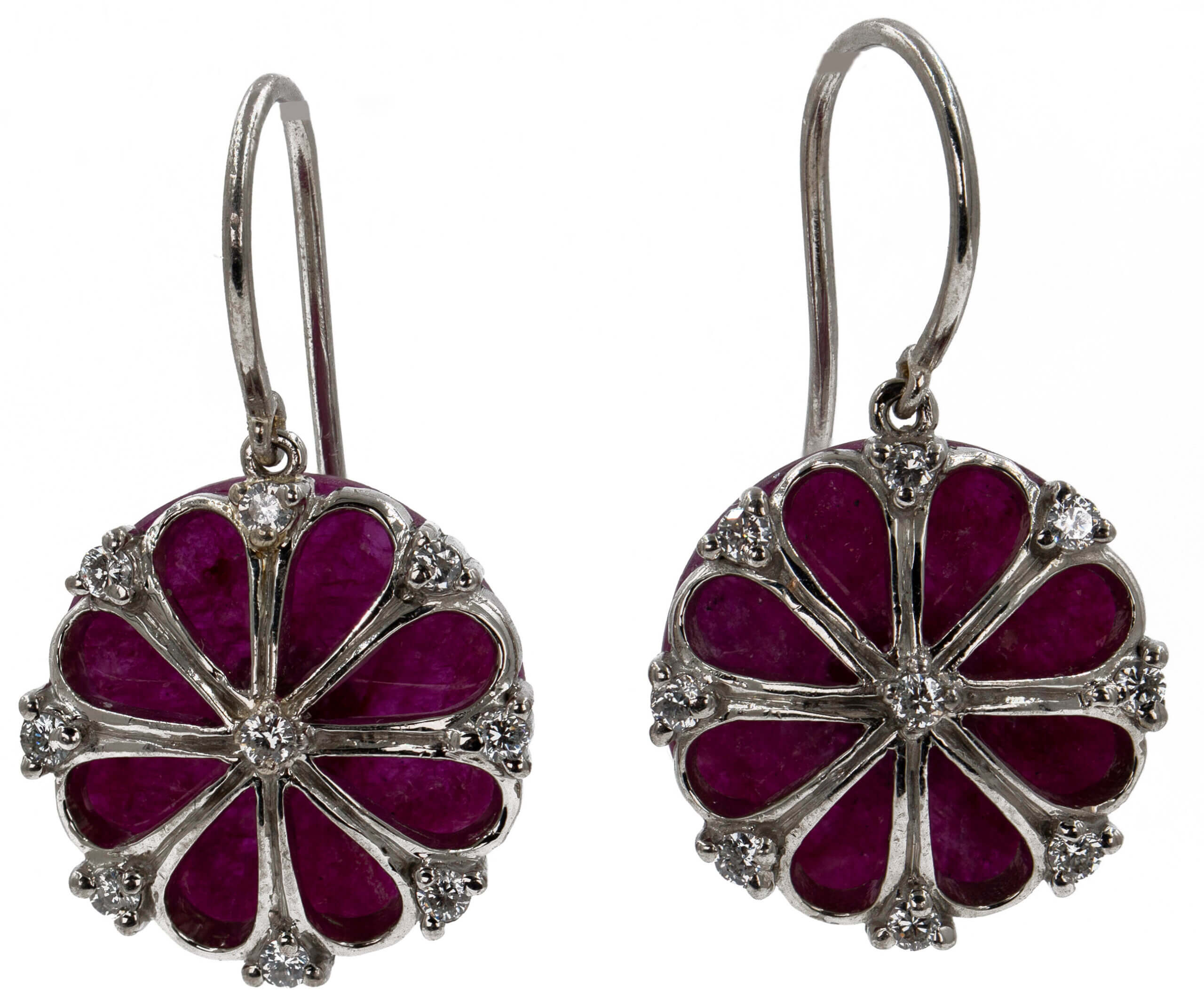
Part of ruby’s appeal to collectors is how differently it appears across the great design periods, many of which are Lippa’s specialties.
- Victorian: Rubies appeared in sentimental, symbolic designs with intricate handwork. Pieces from the Victorian era tend to feel romantic and highly personal.
- Edwardian: Delicate cluster settings and fine platinum work framed rubies in lace-like detail.
- Art Deco: Bold geometry and strong contrast defined the era, and rubies were often paired with diamonds for dramatic effect. The Art Deco period remains one of the most iconic settings for the stone.
- Retro and Mid-Century: Designs grew more sculptural and expressive, with rubies anchoring bold cocktail pieces in gold. Lippa’s collection of mid-century modern jewelry reflects this confident, wearable style.
What Collectors Look For
Evaluating a ruby is different from evaluating a diamond. Color leads every other factor:
Color
The single most important quality. Rich, vivid, evenly saturated red stones command the greatest value and demand.
Origin
A documented source can meaningfully affect both value and collectibility.
Treatment
Most rubies on the market are heat-treated to improve color. Untreated, or “no-heat,” stones are considerably rarer and more valuable, part of why Lippa’s places such emphasis on natural, untreated gems in its estate pieces.
Rarity
Larger fine rubies are scarce, and unusual varieties like star rubies—which display a six-rayed pattern called asterism—are especially prized.
Why Ruby Endures for Modern Buyers and Collectors
Unlike mass-produced modern jewelry, antique and estate rubies offer something increasingly rare: individuality. Each piece is one of a kind, and once it sells, it is gone. That scarcity, combined with ruby’s durability and timeless color, makes it both a meaningful July birthstone gift and a smart addition to a serious collection.
For those drawn to something beyond a traditional diamond, a ruby also makes a compelling center stone. Exploring a range of estate rings and engagement rings reveals how vintage ruby designs stand apart from anything made today.
Discover Ruby at Lippa’s
For July birthdays, meaningful gifts, or a growing collection, exploring curated estate jewelry, including distinctive necklaces and pendants and earrings, offers a chance to own a piece of history in the most captivating shade of red.
Each ruby tells a story of passion and endurance; and once it’s yours, that story becomes your own.