Tues - Friday 10 - 5:30, Thurs 10 - 4, Sat 11 - 4
Art Deco Engagement Rings and Wedding Bands: A Guide to the Era’s Signature Styles
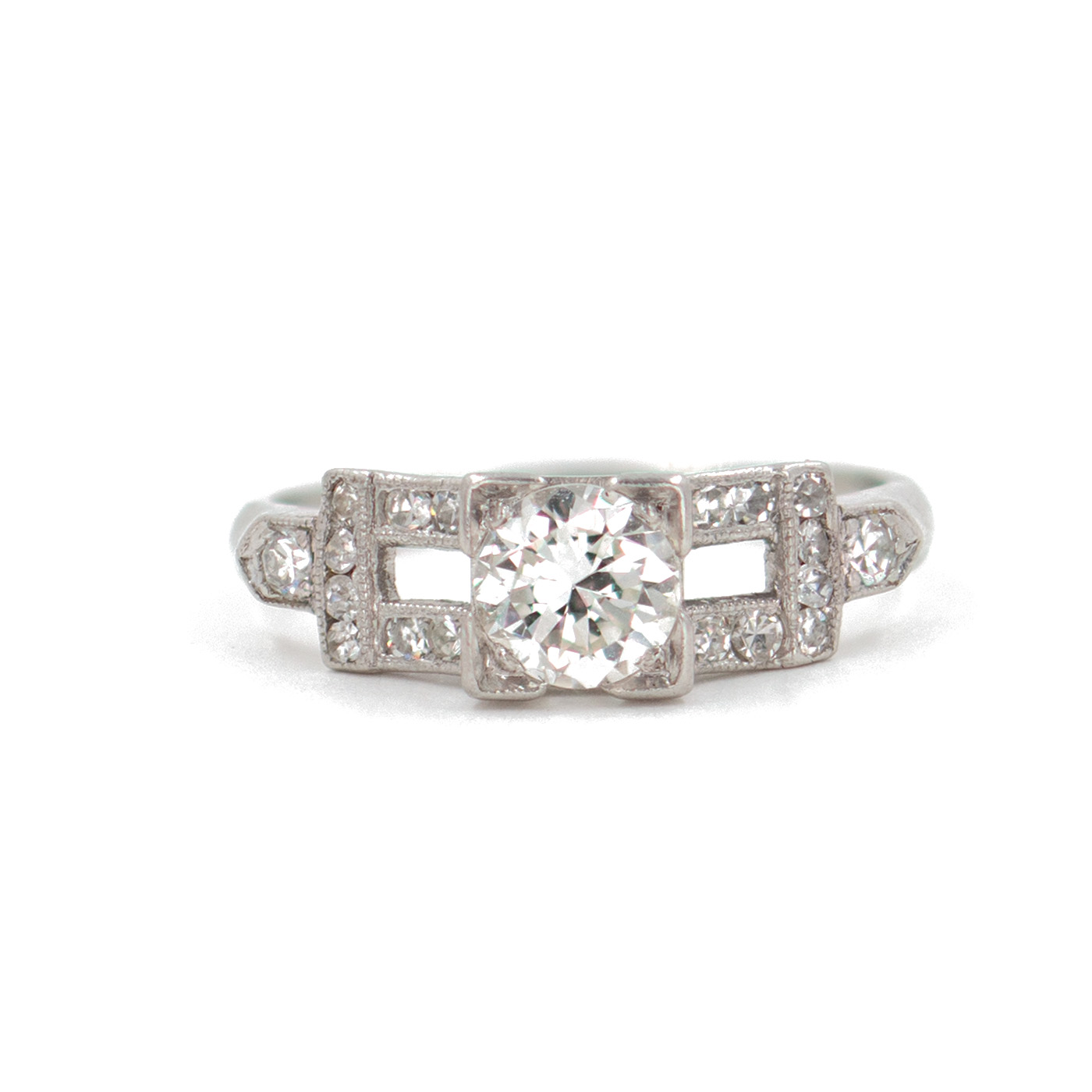
Few engagement rings carry as much personality as those made during the Art Deco era. Crafted between roughly 1920 and 1935, Art Deco engagement rings pair precise geometry with platinum craftsmanship and bold gemstone contrast, and they still look remarkably current today. Lippa’s collection of Art Deco engagement rings offers a close look at how varied these designs can be.
What Makes an Art Deco Engagement Ring Different?
Art Deco rings grew out of a decade fascinated with speed, machinery, and modern architecture, and that influence shows in every detail. Where earlier Victorian rings favored soft curves and romantic motifs, art deco rings are built on symmetry: stepped shoulders, octagonal and hexagonal settings, and repeating geometric patterns that frame the center stone like a small piece of architecture.
Platinum is central to the look. Its strength allowed jewelers to create openwork settings, fine filigree, and slender prongs that softer metals couldn’t support, and its bright white color made diamonds appear even whiter. Many authentic pieces are stamped “PLAT” or “IRIDPLAT,” the latter marking an iridium-platinum alloy widely used during the period, and those marks can be a helpful clue when confirming a ring’s age.
Popular Styles of Art Deco Engagement Rings
Art Deco jewelers worked with a handful of recurring silhouettes, and most vintage art deco rings fall into one of these families:
- Filigree solitaires: A single diamond, often an Old European cut, raised in an intricately pierced platinum or white gold mounting. Die-struck filigree became especially common in American bridal rings of the late 1920s and 1930s.
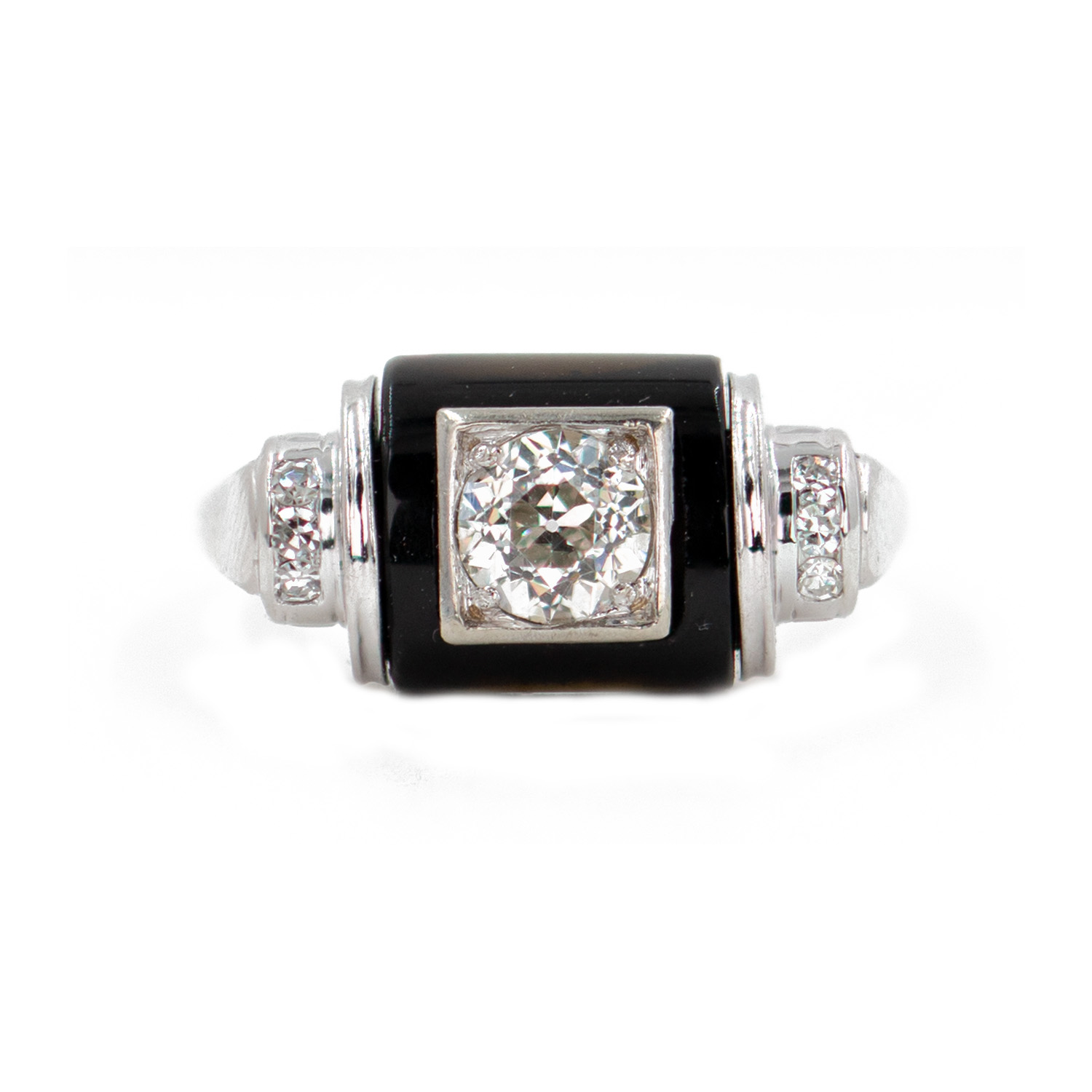
- Geometric halos and clusters: A center stone surrounded by smaller diamonds or calibré-cut sapphires arranged in squares, octagons, or stepped patterns, giving the ring a larger and bolder presence.
- Three-stone and bar designs: Diamonds or colored stones set in a row across the finger, often flanked by tapered baguettes that emphasize the era’s clean lines.
- Illusion settings: Faceted metal plates surrounding a smaller diamond to make it appear larger, a clever technique that caught on in the 1930s.
Each of these styles reflects the same design priorities of balance, precision, and contrast, yet they wear very differently on the hand, so it’s worth comparing several before settling on one.
Diamonds, Sapphires, and Emeralds in Art Deco Rings
Most art deco diamond rings center on an Old European cut diamond, the round predecessor to today’s brilliant cut. With a small table, high crown, and open culet, these hand-finished stones produce broad, warm flashes of light rather than the rapid sparkle of a modern diamond, a quality many buyers find more romantic. Step cuts also came into their own during this period, and emerald, Asscher, and baguette cuts appear often as both center stones and side accents.
Colored stones gave Art Deco rings their drama. The art deco sapphire ring is perhaps the era’s most iconic combination, with rows of precisely cut sapphires set against white diamonds and platinum. Onyx created an even sharper black-and-white contrast, while emerald added rich color to many cocktail and engagement designs. Anyone considering an art deco emerald ring for daily wear should keep in mind that emerald is softer and more prone to chipping than sapphire or diamond, so a protective setting, or a green sapphire in place of the emerald, is worth considering.
Art Deco Wedding Bands and Matching Sets
The era’s design language carried naturally into wedding bands, and an art deco wedding band can complement a vintage engagement ring or stand beautifully on its own. Platinum eternity bands set with small diamonds or channel-set sapphires were especially popular, as were engraved bands decorated with orange blossom motifs, a symbol of love and devotion that became a favorite bridal pattern in the 1920s and 1930s.
Some rings were designed as fitted sets, with the band shaped to sit flush against the engagement ring’s setting. Original matching sets are uncommon today, but many buyers pair an Art Deco engagement ring with a period band of similar metal and detailing for a cohesive look. Lippa’s selection of Art Deco wedding rings and its broader collection of vintage wedding bands make it easier to find a pairing that suits the ring.
What to Check Before Buying an Art Deco Ring
Authentic Art Deco rings have been worn for close to a hundred years, so condition deserves a careful look. Fine filigree and milgrain edges can wear thin over time, and prongs on older platinum settings should be checked to confirm they’re still holding stones securely. Full eternity bands and intricately detailed shanks can also be difficult to resize, so it’s worth confirming sizing options early in the process.
It also helps to understand the difference between an original piece and an Art Deco style reproduction. Many modern rings borrow the era’s look, and while they can be lovely, they don’t carry the hand craftsmanship, history, or rarity of a ring that was actually made in the 1920s or 1930s. A reputable seller should clearly state a ring’s era, disclose any replaced stones or repairs, and provide documentation on the center stone. Choosing an original also carries a sustainability benefit, since an antique ring requires no new mining or manufacturing, a point Lippa’s article on why antique engagement rings are the most sustainable choice explores in more depth.
Find Your Art Deco Engagement Ring at Lippa’s
An Art Deco engagement ring captures a moment in design history when craftsmanship, geometry, and color came together in a way that hasn’t been repeated since. Each surviving ring is one of a kind, and once it finds a new owner, it’s gone for good.
Browse Lippa’s full collection of Art Deco engagement rings, explore the broader Art Deco jewelry category, or compare designs across eras in the complete selection of vintage engagement rings.